
3
2009
Who Discovered the Constellations
 An article by

Stars fascinate people all the time. Ancient and old civilizations have different ways of looking at stars. Some viewed stars as signs, some as other worlds. Farmers, poets, seafarers took the stars as reminders of good and bad luck. Ancient land and sea wanderers used the stars as memory aids so they would not be lost.
On the other hand, farmers read the stars to prepare for a good or bad harvest. This lead to planting and harvesting seasons. In parts of the world where different constellations appeared in different seasons, they used the stars to tell the month instead. For instance, constellation Scorpius can be seen only in northern hemisphere skies in summer.

For the record
The oldest record of star-gazing was found in Sumerian board games around 4000 BC. Sumerians named the stars after their gods. Early Chinese constellation had much in common with Middle Eastern and Western constellation. The Babylonians had divided the zodiac into 12 signs by 450 BC. The present constellation is largely based on Egyptian astrology. The Greeks named 48 constellations.
Constellation controversy
By the end of the 16th Century European seafarers drew maps of the austral hemisphere. Pieter Dirckz Keyser added a few more constellations while on board a ship to the East Indies in 1595. His version was added to Johann Bayer’s, a German cartographer who published an atlas of Europe. More European experts offered new constellations such as the French Nicolas Louis. The International Astronomy Union fixed the number of constellations to 88.
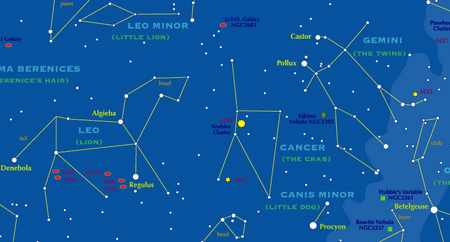
The 12 constellations on the ecliptic side were called as the Zodiacs. Twenty-nine constellations lie between the North Celestial Pole and the ecliptic. The constellation Ophiuchus is part of the ecliptic side. The remaining 47 constellations are found between the South Celestial Pole and the ecliptic side.
Constellations today
Many of the old constellations have been changed. Their positions have been fixed in the sky. Of the 88 constellations, three animals appear twice: Pisces/Pisces Austrinus, Ursa Major/Ursa Minor, and Canis Major/Canis Minor. The northern hemisphere constellations have not changed for the last 2000 years.
Related Guides


Latest Guides
- Five-Minute Spins bei Gomblingo: Schnelle Sessions für schnelle Ergebnisse
- Swift Casino für den Five-Minute Player: Schnelle Spins, Rasche Entscheidungen
- Kurze Bursts, Große Spins: Warum Quick-Session-Players immer wieder ins SkyCrown Casino zurückkehren
- QuickWin: Donde la Acción Instantánea Encuentra Profundidad Estratégica
- LalaBet Casino Review: Snelle Sessies en de Kunst van de Snelle Spin
- Come selezionare i migliori siti di casino online non AAMS affidabili e sicuri
- PGKING Login: Panduan Akses Cepat dan Aman untuk Sesi Bermain Singkat
- Why the Latest Jackpot Buzz Is All About Patrick Spins Casino
- Uncover the Most Family Friendly Walks Across Britain’s Breathtaking Natural Scenery
- Golisimo: Where Modern Gaming Meets Uncompromising Player Experience
Random Guides
- Who Invented the Clock
- Who Invented the Beeper
- Who Invented Boxing
- Who invented Velcro
- Who Invented the Atomic Bomb
- Kumarhane Oyunlar?nda Yakla??m ve Kazanç
- Come scegliere i migliori casino non AAMS sicuri e affidabili in rete
- Who Invented Chalk
- Manuale dettagliato ai siti di gioco non AAMS e alle opzioni legali migliori autorizzate
- Who Discovered America