English flagItalian flagKorean flagChinese (Simplified) flagChinese (Traditional) flagPortuguese flagGerman flagFrench flag
Spanish flagJapanese flagArabic flagRussian flagGreek flagDutch flagBulgarian flagCzech flag
Croat flagDanish flagFinnish flagPolish flagRumanian flagSwedish flagNorwegian flagHebrew flag
Serbian flagSlovak flagTurkish flagHungarian flag    
By N2H


Articles


Subscribe to RSS feed

Who Discovered the Constellation Aries
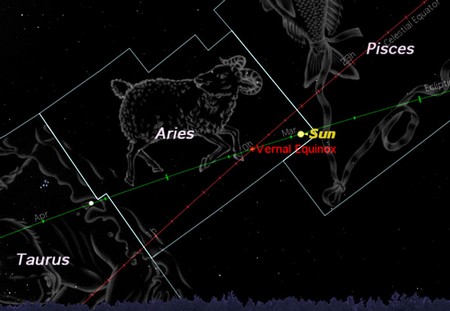
Constellation Aries is found between Taurus and Pisces. When did this begin no one exactly knows. But the Greeks are widely believed to have put the vernal equinox in the constellation.

Constellation Aries according to Greek mythology

The most popular story about how Constellation Aries began is that of Phrinux and Helle.  Athamas, king of Poitia, and his wife Nephele had a son and daughter. The son was named Phrixus, the daughter Helle. Years later Athamas married a second wife named Ino. But Ino fell in love with Phrixus, who did not like her in return. Ino got so hurt by the rejection that she schemed to kill brother and sister. She planned to starve them to death. But Nephele sent a magical ram to rescue them. Phrixus survived, but Helle drowned during the rescue. Upon reaching home, the magic ram told Phrixus to offer him to the Gods. The boy obeyed and the ram found a place among the stars.

Constellation Aries

The Stars in the Constellation Aries

There are seven star clusters that make up Constellation Aries: Alpha Arietis, Gamma Arietis, Beta Arietis, Lambda Arietis, Pi Arietis, 30 Arietis, and 53 Arietis. They form the points that give the constellation a ram shape.

Alpha Arietis (or Hamal) is the brightest of them all. It is red and 50 times brighter and bigger than the sun. Gamma Arietis is made up of two stars. It is blue. Beta Arietis is smaller than Gamma Arietis and is 60 light years away. Lambda Arietis is further still at 133 light years away.  Pi Arietis is also a double star. It has a bluish tint.

Meanwhile 30 Arietis is very visible. It has a magnitude of 6.6. It is yellow. There is another star near it with a magnitude of 7.4. 53 Arietis is made up of  three stars that turn very fast. Experts believe 53 Arietis is part of a supernova.

Aries Who Discovered the Constellation Aries

Meteor showers in the Constellation Aries

There is small galaxy about 5.3 arc-minutes across Constellation Aries. It is believed to be a spiral galaxy. There are also a number of meteor showers around the constellation. One curious meter shower is called May Arietids. It occurs between May and June. Unlike most meter showers May Arietids happens during the day.

The two other visible showers are Epsilon Arietids and the Delta Arietids. The rest are too difficult to see.

Recent findings

Recently it has been proved that some of Constellation Aries’s stars have planets. A number of  new galaxies have also been discovered. Some of them are NGC 772, NGC 972, and NGC 1156.  They cannot be seen by the naked eye.

Constellation Aries is a spellbinding sight in the sky. According to astrology, people born under the sign of Aries are bold and optimistic.

Related Articles:

Who Discovered Gemini

In astrology Gemini people are difficult to pin down. They are very creative and mysterious. The only downside is, what they like today they would end up hating tomorrow.

Clusters of  Gemini

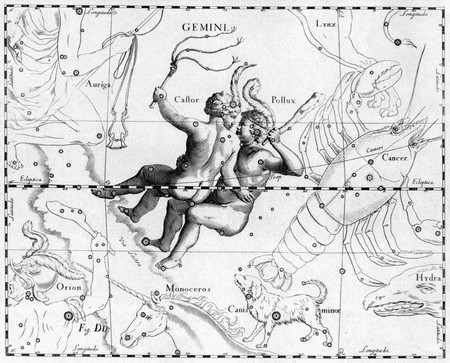
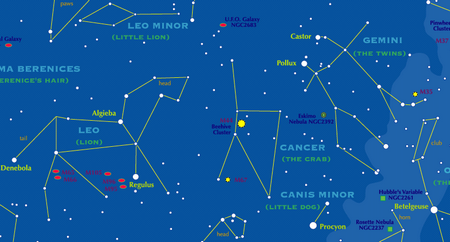
Gemini means “twins” in Latin. It is a constellation named after the twins Castor and Pollux in Greek mythology. The constellation is found between Taurus and Cancer. To its north are Lynx and Auriga, to the south Monoceros and Canis Minor.  Constellation Gemini has a cluster called Open Cluster M35. Northeast of Gemini is another cluster of nebula called NGC 2371. Gemini’s southern tip has Abell 21, otherwise known as the Medusa Nebula.

Gemini took its name from legendary characters in Greek mythology. Since it is a constellation, no one knows for sure who saw it first. Stars clusters have been up in the sky for the longest time.

Gemini1 Who Discovered Gemini

The myth behind Gemini

According to popular myth, Castor and Pollux, were known together as the Dioscuri.  Their story involved cattle theft. As such, the story was used as a symbol for the Milky Way as a herd of cows. When seen in astronomical maps, Gemini tended to lean away from the Milky Way. At times they are seen with one of the twins within the Milky Way, the other outside. So it appears as though Castor is taking the cattle while Pollux looks on. The story of Gemini is said to have given rise to the myth of the cows of Geryon.

Earliest Observers of Gemini

As early as 6000 years ago the Hindu history book called the Rig Veda already described the stars of Gemini. The Rig Veda called Gemini’s stars as the twin horsemen of the dawn. In ancient India Gemini’s stars were known as Nakula and Sahadeva. These two stars could be clearly seen at dawn in spring. This led to the belief that the twin stars meant the coming of the spring equinox. In ancient India Gemini meant Mithuna, the twins. So the old Western and Eastern meanings were one and the same.

Gemini Who Discovered Gemini

The teachings of ancient India spread westwards to the Far East around 5000 BC. It caught on in Babylon as it did in the rest of the Middle East. Babylonians adopted Indian astronomy to keep track of the seasons for sea travel. Ancient Babylonians called Gemini as Mastabba Galgal, which meant the great twins. But the Babylonains put a spin to it: They came up with their own epic whose heroes were twins Gilgamesh and Enkidu. The great twins fought the gods in search of immortality.

Gemini in ancient Egypt and Greece

Ancient Egypt’s version took the form of twin goats which stood for the two stars told about in the Ramissede Hour Tables. The Ramissede was a book that told time through the position of stars in the night sky. Ancient Egyptians had observed that the two stars of Gemini did rise and follow each other at dawn.

Around 1000 BC, the Greeks picked up on that as well. The Greeks borrowed freely from ancient Babylonian and Egyptian astronomy. Perhaps they were a little more creative in that they embellished the stories behind the constellations with human drama.

When the Romans invaded Greece, the vicious cycle of lifting and borrowing went on. The Romans changed Polydeuces’s name to Pollux. But it came to a point where Gemini took on a single status because either one of the old names went missing for some time.

Gemini to according to sailors

Today, folk sailors still believe Castor and Pollux guide their ships and point their way back. In times of danger, Castor and Pollux send St. Elmo’s fire to signal an oncoming   bad luck.

Related Articles:

Who Discovered Constellation Sagittarius
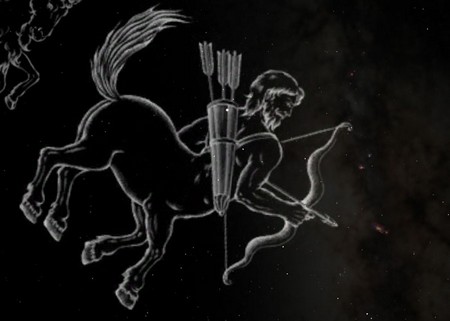
Sagittarius contains a number of dazzling nebulae. Seen through a telescope, Sagittarius looks like a universe of light. In Latin Sagittarius means “the archer.” The constellation is associated with a centaur drawing a bow.  Sagittarius is found in Capricorn to the east and Ophiuchus to the west.

One of Sagittarius’s most spectral sights is the Lagoon Nebula (M8). It is considered a diffuse nebula: In the sky they look like scattered gold dusts.   Lagoon Nebula was discovered by Le Gentil in 1747.

Earliest sightings of Sagittarius

Ancient Babylonians referred to Sagittarius as Pabilsag or Nergal, a god with wings and the head of a lion.  The Greeks pictured Sagittarius as a centaur, a creature that was half horse, half human.

According to a popular Roman legend at the time, Chiron was a centaur who was the son of Saturn and Philyra. Saturn changed himself into a horse to break free from his very possessive wife, Rhea.

Sagittarius Who Discovered Constellation Sagittarius

Being the son of a god, Chiron was born very smart. He was exceptionally good at hunting, poetry, music, war, medicine, and the study of the stars. Chiron taught young Greeks in a cave beside the mountain.  His pupils observed him to be quiet and reserved. He seemed to be aloof and lost in his thoughts most of the time. He was never known to have a girlfriend.

Now one of his pupils was Hercules. Hercules would come to the came even when there was no class. He liked to talk for a bit with his teacher long after classes were finished. On one such occasion, and with wine to go with the talk, a pack of drunk centaurs attacked student and teacher.  In the wild scramble one of Hercules’s poisoned narrows scraped Chiron by the arms. The arrow’s poison was made from the blood of Hydra. Chiron was immortal, therefore he could not die. But he could not endure the poison’s pain.

To relieve himself, he gave up his immortality in exchange for Prometheus’s freedom from torture. Zeus, the supreme god, took the offer with much respect for Chiron. In the end instead of leaving Chiron in Tartarus as agreed, Zeus placed him in the sky as constellation Sagittarius.
When you look at the southern hemisphere skies between June and July, Sagittarius outshines the rest of the constellations. At the height if the winter solstice the sun appears in Sagittarius.

Constellation Sagittarius

Sagittarius according to the Greeks

The ancient Greeks told of the story of Crotus, a satyr that lived with the muses on Mount Helicon. Crotus played music and sang in the choir. He was the inventor of clapping at the end of a play and music. Crotus always did that with perfect timing and with such flourish that he endeared himself to the Muses. When Crotus died, the Muses entreated Zeus to honor the great clapper by placing him up in the heavens. Zeus made a constellation of a centaur instead of a satyr, recognizing Crotus’ other skill as a great rider.

In some quarters today, there is still confusion about whether Sagittarius was Chiron or Crotus.  It is more likely that the Romans tweaked the story. Ancient historians like Ovid, Hyginus, and Diorosos concurred that Chiron was a Centaur and not a satyr.

People born under constellation Sagittarius

Sagittarians are known to be very optimistic. As such they are full of energy.  They also love adventure and travel.

Related Articles:

Who Discovered the Constellations

Stars fascinate people all the time. Ancient and old civilizations have different ways of looking at stars. Some viewed stars as signs, some as other worlds. Farmers, poets, seafarers took the stars as reminders of good and bad luck. Ancient land and sea wanderers used the stars as memory aids so they would not be lost.

On the other hand, farmers read the stars to prepare for a good or bad harvest. This lead to planting and harvesting seasons. In parts of the world where different constellations appeared in different seasons, they used the stars to tell the month instead. For instance, constellation Scorpius can be seen only in northern hemisphere skies in summer.

Constellations Who Discovered the Constellations

For the record

The oldest record of star-gazing was found in Sumerian board games around 4000 BC. Sumerians named the stars after their gods. Early Chinese constellation had much in common with Middle Eastern and Western constellation.  The Babylonians had divided the zodiac into 12 signs by 450 BC. The present constellation is largely based on Egyptian astrology. The Greeks named 48 constellations.

Constellation controversy

By the end of the 16th Century European seafarers drew maps of the austral hemisphere.  Pieter Dirckz Keyser added a few more constellations while on board a ship to the East Indies in 1595.   His version was added to Johann Bayer’s, a German cartographer who published an atlas of Europe. More European experts offered new constellations such as the French Nicolas Louis. The International Astronomy Union fixed the number of constellations to 88.

Constellations Who Discovered the Constellations

The 12 constellations on the ecliptic side were called as the Zodiacs. Twenty-nine constellations lie between the North Celestial Pole and the ecliptic. The constellation Ophiuchus is part of the ecliptic side. The remaining 47 constellations are found between the South Celestial Pole and the ecliptic side.

Constellations today

Many of the old constellations have been changed. Their positions have been fixed in the sky. Of the 88 constellations, three animals appear twice: Pisces/Pisces Austrinus, Ursa Major/Ursa Minor,  and Canis Major/Canis Minor. The northern hemisphere constellations have not changed for the last 2000 years.

Related Articles:

Who Discovered Constellation Leo

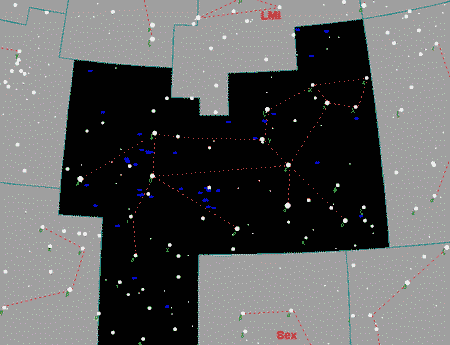
Constellation Leo is very easy to spot in the night sky. In spring it takes up much space in the northern hemisphere. In autumn Leo runs to the southern hemisphere. Leo is the fifth zodiac sign, but is  the most visible of all.

How do you know you are looking at Leo? You are supposed to see a crouching lion that looks to the west. You should see the head and mane clearly, above which hangs a sickle of stars.  If the sickle is not sharp enough, you should see an inverted question mark at least.

Leo’s brightest star is Regulus. It is found south of the pointy stars of the Big Dipper, northwest of Virgo. Leo shines brightest on or around March 1.

Constellation Leo

Leo in ancient Egypt

The figure of a lion has been associated with the sun since the earliest times. Belief in the lion as symbol of the sun began in ancient Persia. More than 5000 years ago, the sun “passed over” Persia and Egypt at the height of the midsummer solstice. From then on Leo was lumped in with the coming of high summer. Leo’s time was poetically called “the realm of the sun”.  On closer inspection, you cannot miss the Sphinx’s body, which is that of a lion.

Even in ancient Africa, the lion stood for strength and power. It is no king of the beasts for nothing.

Leo in the story of Pyramus and Thisbe

According to Roman mythology, Leo was the symbol of the Nemean lion, one of Hercules’s greatest fights. Hercules was tasked to skin a gigantic lion whose hide did not even bruise against metal and stone.  Being a demigod, Hercules managed to pin down the lion with his bare hands. He choked the lion to death and skinned it with the use of its own claws. The hero took home the hide as his trophy, but not without turning it into an invincible cloak. The lion’s head he made into a helmet.

To the ancient Greeks, the Leo figured in the love story of Pyramus and Thisbe. Ovid’s Metamorphosis recounts of how Pyramus and Thisbe’s parents objected to their romance. Sounds like Romeo and Juliet? It must have been one of the ancient sources. What the two-star-crossed lovers did was talk through a tiny hole in the wall that divided their houses. One day they hatched a plan to meet far outside the city. It had to be right next to a mulberry tree. When the day came, Thisbe came all by herself. Pyramus was nowhere in sight. She waited for some time and soon enough a lion fresh from a kill strayed by.

Constellation Leo

Thisbe ran for her life. She was just quick enough to get her body out of the lion’s way. Instead the lion snapped and pawed at a piece of her veil. Pyramus arrived late to see Thisbe’s veil in bloody pieces. He instantly thought Thisbe was mauled dead by the lion. He pulled his sword and drove it deep into his body. Pyramus did not think twice to kill himself to be with his love. Thisbe came back and saw her dead Pyramus. She threw herself on Pyramus, cried hard, and thrust the bloodied sword into her body. The lovers’ blood soaked into the white mulberry flowers. And the deep red color stayed ever since. The supreme god Zeus hung Thisbe’s veil up in the sky, with the lion just above it.  The veil was later known as Coma Berencies.

Leo in ancient Middle East

Leo’s moon, Regulus, got its name from Copernicus. The name originally meant “the little king.” The ancient Sumerians called  Regulus as the “star of the king.” In ancient Persia and Iraq, Regulus was called “the flame” or “red fire.” They associated red fire with the onset of an extremely hot summer. Ancient Persians considered  Regulus  one of the four royal stars:  The other royal stars were Fomalhaut, Aldebaran, and  Antares.

By 2300 BC ancient astronomers in the Middle East had observed that the sun moved in near Regulus. As it did, the summer grew hotter and hotter. The ancients gave this role to Sirius at a later time.

Meanwhile, the stars of Leo formed a horse in  ancient Chinese zodiac.

Leo’s stars

Two of leo’s famous stars are Algiebra and Wolf 359. Algivebra is  abinary system (meaning a pair). The brighter one looks like giant orange, right next to a giant ripe lemon (the smaller pair).

Wolf 359, on the other hand, the least visible of Leo’s stars, in spite of being popular. It was discovered by Max Wolf in 1918.

Related Articles:

Who Discovered Venus

Venus is the earth’s nearest neighbor. Aside taking its name from the Greek god of beauty, Venus is also known as the Evening Star. Venus can be seen in the sky before sunrise and after sunset. Venus is closer to the sun than it is to earth. The 6th largest planet in the solar system, is a rarity: It is the only planet that orbits clockwise. Venus rotates with barely 1% difference.

Earliest sightings of Venus

In ancient Hindu astrology Venus is called Shukra. Meanwhile the Babylonians had observed Venus as early 1600 BC. They called the planet Ishtar, who was the goddess of love and womanhood.

Long before the telescope was invented in the West, Venus known as the wandering star. Westerners thought the morning and late afternoon Venus were two different planets. Phythagoras was the first to know they are one and the same. He discovered that in the 6th Century BC. But he thought Venus goes around planet Earth. In the 17th century Galileo noticed that Venus had traits like the moon: Venus appeared to have lumps on either side and at times took on a crescent shape.

Venus Who Discovered Venus

Venus observers

Mikhail Lomonosov, a Russian genius,  first discovered Venus’ s atmosphere in 1761. Johann Schroter made further observations of the planet’s atmosphere in 1790. He figured out that when Venus appears as a crescent, its cusps stretches beyond 180 degrees.  He was correct in guessing that this caused by sunlight breaking up in a dense atmosphere. Chester Smith Lyman first discovered the ring around dark side of the planet. Venus’ atmosphere is very dense. This causes a problem to scientists who want to know the planet’s rotation period.  Giovanni Cassini and Johan Schroter thought Venus had a 24-hour rotation period.

Mikhail Lomonosov

Venus and Earth

Venus shares some traits with planet Earth. Like Earth, Venus has silicon rocks on its surface. That is why Venus is considered as Earth’s sister planet. Venus is like Earth in terms of size and makeup. But Venus’s atmosphere is too dense to host any life form: it is full of sulfuric acid clouds. The extreme heat of the atmosphere dries up all bodies of water.  The burning temperature is caused by huge amounts of carbon dioxide and sulfur dioxide.   Venus’s surface is far hotter than Mercury’s. Mercury is closer to the sun than Venus.   Venus’s atmospheric pressure is 90 times stronger than Earth’s.

Majority of Venues’ surface features are named after women.

Moreover, Venus and Earth has  the same core that is made up of compact iron deposits.  But Venus’ mantle is riddled with   thawed out rock formations.  The center of Venus is very similar to that of Earth.

Space missions to Venus

The first space probe mission to Venus was the Russian Venera 1. But Earthly contact was lost seven days after it went into space. The first spacecraft that successfully came close to Venus was America’s Mariner 2. It did so in 1962. Since then Venus has been visited by more than 20 spacecrafts.

Related Articles:

Who Discovered Saturn

In the same manner that Gemini and most constellations were not discovered, Saturn has no known discoverer, either. Saturn and the rest of visible and partially seen space objects have been known by man since prehistoric times.  Saturn’s rings were not seen, until the telescope was invented.

On a clear night Saturn is easily visible in the sky. The ancient Greeks named planet Saturn after their god of time and agriculture. Saturn’s rings were not known until 1655. Galileo saw them first. What he saw first in fact were two humps on both sides of the planet. Christian Huygens later found out they were rings.

Saturn Who Discovered Saturn

How Galileo and Huygens saw Saturn

Galileo set out to study Saturn quite confused. He was not sure whether Saturn was one planet in three or three planets in one. Christian Huygens picked up where he left off. He cleared up the mystery of the rings in 1655. What Galileo mistook for globes Huygens proved to be rings. They did not appear as sharp and distinct as they are seen today, but Huygens was at least correct. Huygens saw Saturn’s largest moon, Titan, in 1655. Saturn’s rings were clearly understood twenty years forward when Domenico Cassini came around. He proposed that Saturn’s rings are  broken in many parts.

By 1800 Saturn’s six other satellites were discovered by other unnamed astronomers.

Saturn today

More than 40 of Saturn’s moons have been named since then. But Saturn remains a lethal planet: it is 97% hydrogen, 2.5 % helium, and the rest is ammonia. For its size no one even suspect that Saturn is the least dense of all the planets in the solar system. Saturn is even lighter than water!

New space discoveries are made almost every day. Today, deep space is no longer as mysterious as it was thousands of years ago.

Christian Huygens

There is an ongoing space mission to Saturn to this day. Spacecraft Voyager has taken close-up images of Saturn and its rings. The photographs reveal the huge gaps between the rings. The gaps are called the Encke Division and Cassini Division. The latest images on Saturn’s moon, Titan, were taken by NASA’s Cassini orbiter.   The pictures show that there is organic stuff found on the planet’s surface.

But unlike organic molecules found on a planet like Earth, Saturn’s Titan cannot support any life form.  Titan’s temperature is below 180 C. Aside from that, there is no sign of water and oxygen, either. But experts say it is possible that Titan and Earth’s atmosphere may have been the same 4 billions years ago.
Saturn’s companion moons

In 2005 NASA’s Cassini-Huygens mission took a much sharper picture of Saturn’s surface and moons. And this was what it showed: Saturn has other moons that appear like a rubble pile; frequent violent storms on the planet; and a powerful magnetosphere. Saturn’s moons are like giant corks when seen from the spacecraft.

Just when Earthlings thought they have known enough Saturn moons, another small moon was seen about 5 kilometers across. The moon was named Polydeuces, meaning “companion” or “Trojan” moon. This makes Saturn the only planet to have companion moons.

Related Articles:

Who Discovered the Mitochondria

Mitochondria are the powerhouse of the cell. You can say supplies electricity the cell.  Mitochondria are organelles in the cells that have special functions: They make ATP (adenosine triphosphate) that keeps the cells in good running condition. Other than that,   mitochondria are responsible for cell reproduction and cell death.

Earliest studies on the mitochondria

The first recorded study ever made in the mitochondria was made by Richard Altman in 1840. He came to know about them and  called them bioblasts. Carl Benda coined the word mitochondrria in 1898. He got it from the Greek word mitos, meaning thread, and chondros, meaning granule.

Albert von Kolliker  discovered the existence of mitochondria around 1857. He was studying human muscle cells when he noted strange granules in them.

Mitochondria Who Discovered the Mitochondria

Discovery of mitochondria functions

Over the next few decades more scientists took the mitochondria seriously. By and large each one of them had his own contribution to the field. Some focused on  mitochondria’s functions, some on their structures. One important name in mitochondria’ science is Otto Heinrich Warburg. He initially proposed that a special enzyme within the cell helps in the making of oxygen. When he used cyanide on the cells, it had an effect right down to the minutest level. In later years he was able to come up with a cure for cancer (cesium chloride). But he was called names by the scientific community.

Albert von Kolliker

More research on the mitochondria was undertaken by David Keilin in 1923. He probed how electrons changed inside cells while in the process of oxidation. For his part Keilin discovered the inner membrane of  mitochondria, which he called cytochrome C.

Six years later, C.H. Fiske and Y. Subbarow successfully isolated mitochondria’s ATP. Soon after more related experiments were made by H.M. Kalckar and V A Belitser. They proved how cells “breathe” better when added with phosphate and protein.  Cells breathe when they get oxygen from the blood. Fiske and Subbarow later called this process as oxydative phosphoryaltion.

By the 1950s studies on mitochondria were going full swing. This time more attention was given to their functions. These were successfully observed by Eugene Kennedy and Albert Lehnigher. Peter D. Michell came up with a theory which he aptly called “chemiosmotics”  from his studies on mitochondria membranes. He proved that during cell respiration, hydrogen ions spread across  mitochondria’s membranes and that they actually convert food into ATP to make energy.

Paul Boyer discovered the mitochondria’s role in making ATP from inorganic phosphates. For that he won the Nobel Prize in 1997.

Mitochondria’s outer and inner structure

There are membranes outside and inside the mitochondria. The outer layer is thick and full of proteins. It allows only small molecules. Mitochondria’s inner membrane has folds called cristae. Moreover, the inner membrane has an enzyme that helps the cell to make ATP. This enzyme is known as the matrix.

Mitochondria and modern medicine

Knowing mitochondria’s  structure helps  scientists know more about the DNA. Experts believe there is a link between DNA and mitochondria. DNAs with defective mitochondria, for example, give doctors a clue what diseases a certain person is prone to.

Related Articles:

Who Discovered Mercury

The earliest record about planet Mercury is found in Babylonian and Sumerian writings about 3000 years ago. There is also mention of Mercury in ancient China, India, and in the tombs of Egypt. The evidence dates back to 1500 years BC. Mercury is hard to see because it does not go far from the sun. This was the same problem that ancient astronomers faced.

Ancient Greeks called Mercury by two names: Apollo and Hermes. The Romans gave the planet its present name because Mercury is observed to move fast before dawn and after sunset.

Mercury Who Discovered Mercury

Mercury’s new “discoverers”

But in recent history it was Johann Hieronymus Schroeter who is believed to have first observed the planet. He patiently drew Mercury’s surface and kept a record of his notes.   Schroeter continued to observe the planet until his death in 1816. However, by today’s standards, his illustrations are thought incorrect.
Percival Lowell and Schia also saw the same dark streaks on Mercury’s surface. They thought those were the same canals that were seen on planet Mars. Using a much stronger telescope, Eugenios Antoniadi was able to map out Mercury’s surface in sharper detail. His maps were so precise that they were used for the next 50 years. The so-called Martian canals turned out to be optical illusions.
Today images of Mercury are taken by Mariner 10.

Johann Hieronymus Schroeter

Mercury’s surface

Mercury is a harsh and hot planet. There is evidence of a battered past on the surface of the planet. Mercury was probably caught up in the middle of chaos during the Big Bang. There are huge craters across the planet’s surface. Traces of lava flow are found around these craters.  Mercury’s biggest crater is called Beethoven. It measures 643 kilometers in diameter. The largest feature on the planet is the Caloris Basin. It is 1300 kilometers in diameter. Experts believe it was formed by the crashing of a gigantic object into Mercury.  In spite of being hot, Mercury has craters with ice in them.  This is so because the sun cannot reach some parts when the planet orbits and tilts.

Mercury’s present and future

Mercury has no atmosphere.  Between the coldest and hottest parts, the temperature difference is 600 degrees. Mercury orbits around the sun for 88 days but takes 58 days to go around once. Compared with Earth time, a year on Mercury lasts for a day and a half.  Mercury is the nearest planet to the sun as well as the smallest planet in the solar system.  As a dry and airless planet, Mercury is too small for gravity. Its small size does not allow any atmosphere to form for long. But traces of helium, sodium, calcium, oxygen, and potassium are found on the planet’s surface.

Moreover, Mercury’s heat burns its already thin atmosphere. Mysteriously, it is always replaced. The sun hits Mercury seven times strong as it hits Earth.  The sun appears more than twice its size in Mercury’s sky than it does on Earth.

Mercury has no moons. When the sun reaches its last days, Mercury will burn with it, including planet  Earth.

Related Articles:

Who Discovered Planet Mars

Mars is the fourth planet from the sun. It is also called the Red Planet. Mars  turns red because of huge iron dust deposits on its surface.

Mars’ many names in the past

In the old days Egyptians called Mars as “Har Deucher” (The Red One). The Babylonians called Mars as “Nergal” (The Star of Death).  The Greeks named Mars after Ares, the god of war. The Romans gave Mars its present name.

Scars on Mars

The strange-looking scars on Mars’ surface was first seen by Christian Huygens in 1659. He actually believed there were creatures living on the planet. The odd-looking figures were later named Syrtis Major.  But Giovanni Schiaparelli had a stranger theory: He believed these crooked lines were water canals built by aliens!

Mars Who Discovered Planet Mars

No one never really discovered planet Mars. But its moons were first seen in 1877 by  Asaph Hall.  He named the two moons of Mars Phobos and Deimos. Phobos means fear, Deimos means panic. Hall named the moons after the horses that drew the chariot of Mars in Roman mythology.

Earth’s closest neighbor

Mars goes around its axis once every 24 hours and 37 minutes. It turns around its orbit within pretty much the same time as planet Earth does. Mars’s air is very thin and is almost entirely made up of carbon dioxide. There are times a cloud of dust covers much of the planet. It is noteworthy that there are many striking similarities between Mars and Earth. Like Earth, Mars is also home to wide canyons, snow-capped mountains, and sand banks.
Earth and Mars

Mars and Earth orbit around the sun almost at the same speed. A Martian day is almost as long as an Earthling day (about 24 hours and 39 minutes). In that case, a year on Mars is almost as long as a year on Earth. The Earth has one moon, while Mars has two. Mars’s moons are called Deimos and Phobos. Phobos is a weird moon: It rises and sets for only about 11 hours. It sets in the east and rises in the west. Deimos, meanwhile, rises in the east and sets in the west for more  than two days.

Asaph Hall

Shades of light and dark

The Red Planet was first seen up close from Mariner 4 in 1965. Mars was widely believed to have seas and oceans. Scientists thought this was possible because of light and dark shades on the planet’s polar latitudes. Their observations were later proven wrong. The dark stripes seen from Mariner 4 turned out to be an optical illusion.  The other tell-tale sign that there might be life on Mars is the changing colors on its surface. Observers take this for seasonal changes that affect vegetation on the planet: Plants die out in warm months and grow back in cold months.

Water in Mars

But recent radar feeds from Mars Express and Mars Reconnaissance show that Mars harbors water. The photographs reveal bodies of water and ice at the planet’s poles. In 2008 the Phoenix Mars Lander took water samples from Martian soil. According to biologists, Mars sanitizes its own atmosphere. This happens because of the strong solar  ultraviolet radiation on Mars’s surface. This leaves the planet’s soil too dry to support  any life form.  But the issue of an extinct Martian civilization remains a hotly debated subject.

Mars is around 228 million kilometers away from the sun. If it drifted anything closer than that, the planet could have burnt out a long time ago.

Related Articles:

« Previous Entries

Categories